Art Integrated Learning: NEP 2020 and NCFSE 2023
About this program
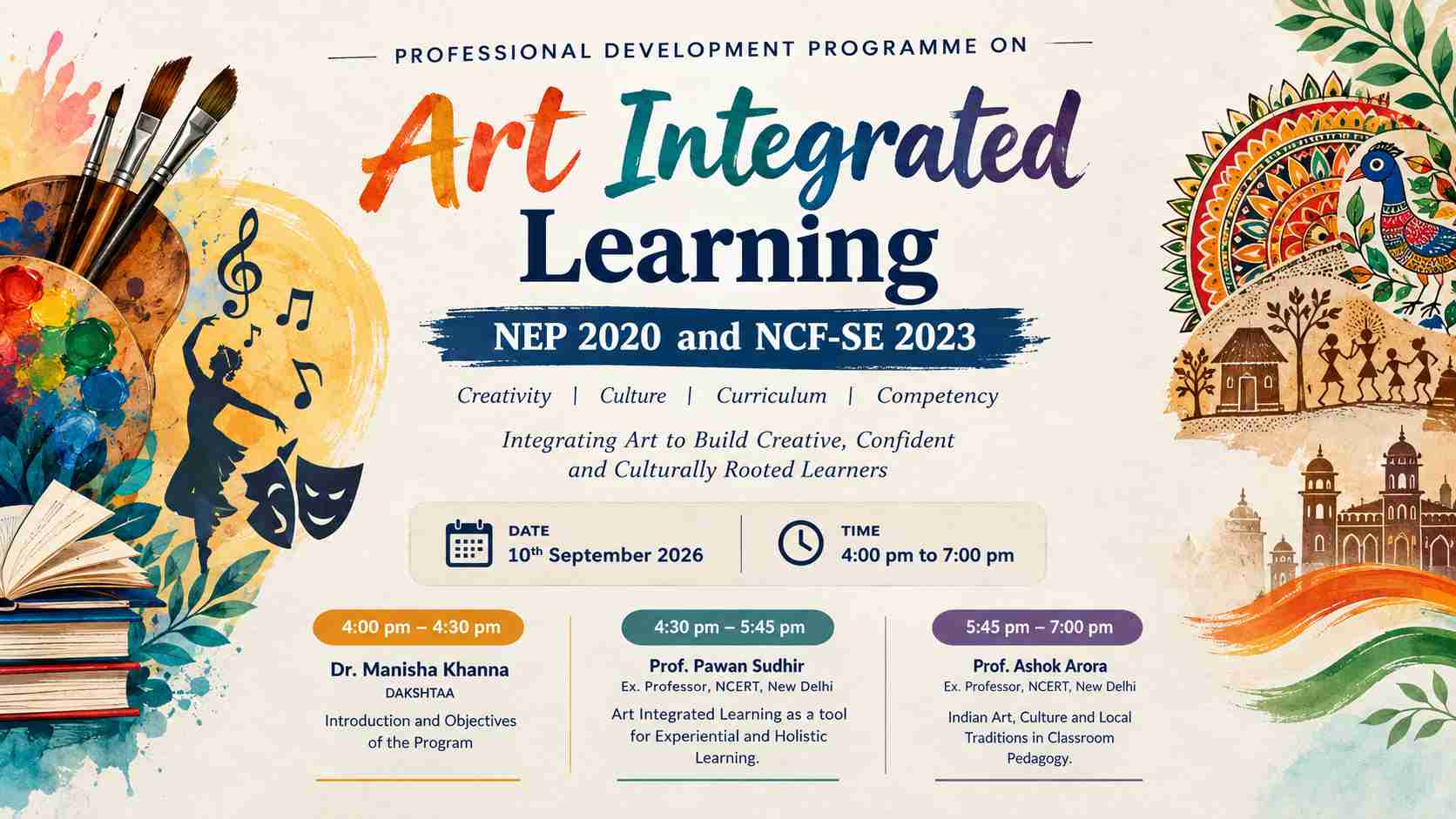
Professional Development Programme on Art Integrated Learning: NEP 2020 and NCF-SE 2023 DATE: 10TH September 2026 Time : 4:00 pm to 7:00 pm Introduction Art Integrated Learning (AIL) is an innovative and learner-centered approach that uses different forms of art as a medium for understanding and exploring concepts across the curriculum. It makes learning more experiential, joyful, creative and meaningful. The National Education Policy (NEP) 2020 emphasizes holistic, multidisciplinary and experiential education, while the National Curriculum Framework for School Education (NCF-SE) 2023 gives significant importance to creativity, cultural understanding, competency-based learning and the integration of different curricular areas. Art Integrated Learning provides teachers with opportunities to move beyond traditional classroom practices and create learning experiences that encourage imagination, expression, collaboration, critical thinking and appreciation of India's rich cultural heritage. The PDP aims to equip teachers with practical strategies for incorporating art into everyday teaching-learning processes in accordance with the vision of NEP 2020 and NCF-SE 2023. Session 1: Art-Integrated Learning as a Tool for Experiential and Holistic Education Art can transform the classroom into an engaging space where students learn by doing, creating, observing, performing and reflecting. Instead of treating art only as a separate subject, teachers can integrate visual arts, music, dance, theatre, storytelling, craft and other creative activities with different subjects. For example, students may represent a mathematical concept through a drawing or pattern, explain a scientific process through a role play, present a historical event through theatre, or explore language through storytelling and poetry. Such activities provide multiple ways for students to understand and express their learning. AIL also supports the development of important competencies such as: • Creativity and imagination • Critical and analytical thinking • Communication and self-expression • Collaboration and teamwork • Problem-solving • Observation and reflection • Confidence and emotional expression The role of the teacher changes from being only a transmitter of information to that of a facilitator, mentor and designer of meaningful learning experiences. Teachers can plan activities that cater to different learning needs and allow students to demonstrate understanding through varied forms of expression. Session 2 : Indian Art, Culture and Local Traditions in Classroom Pedagogy NEP 2020 and NCF-SE 2023 encourage learners to develop a strong connection with India's diverse cultural traditions. Art Integrated Learning provides a natural platform for bringing Indian and local art forms, crafts, music, dance, theatre, storytelling and folk traditions into the classroom. Teachers can introduce students to regional art forms such as Madhubani, Warli, Gond and other local traditions, while connecting them with curricular concepts. Folk songs, local stories, traditional crafts, festivals and indigenous knowledge can also become valuable learning resources. Such integration helps students understand that education is closely connected with their community, culture, environment and heritage. It also promotes respect for India's diversity and encourages students to appreciate the contribution of local artists and traditional knowledge holders. For instance, students can study geometric patterns through traditional designs, explore environmental themes through folk art, learn regional history through local stories, or understand language and oral traditions through folk songs and storytelling. Expected Outcomes of the PDP • After participating in the programme, teachers will be able to: • Understand the significance of Art Integrated Learning in the context of NEP 2020 and NCF-SE 2023. • Design experiential and interdisciplinary learning activities. • Integrate visual and performing arts with different school subjects. • Use Indian and local art forms as meaningful classroom resources. • Encourage creativity, collaboration and self-expression among learners. • Develop learner-centred and joyful classroom practices. • Use art-based activities for formative and competency-based assessment. • Connect classroom learning with students' culture, community and surroundings. Conclusion Art Integrated Learning is not merely the addition of artistic activities to the curriculum; it is a pedagogical approach that enriches the entire learning experience. By integrating art with academic concepts and connecting learning with India's cultural heritage, teachers can create classrooms that are creative, inclusive, experiential and joyful. The PDP on “Art Integrated Learning: NEP 2020 and NCF-SE 2023” will therefore support teachers in translating policy recommendations into effective classroom practices and in nurturing learners who are creative, confident, culturally rooted and capable of applying their learning in meaningful contexts.