
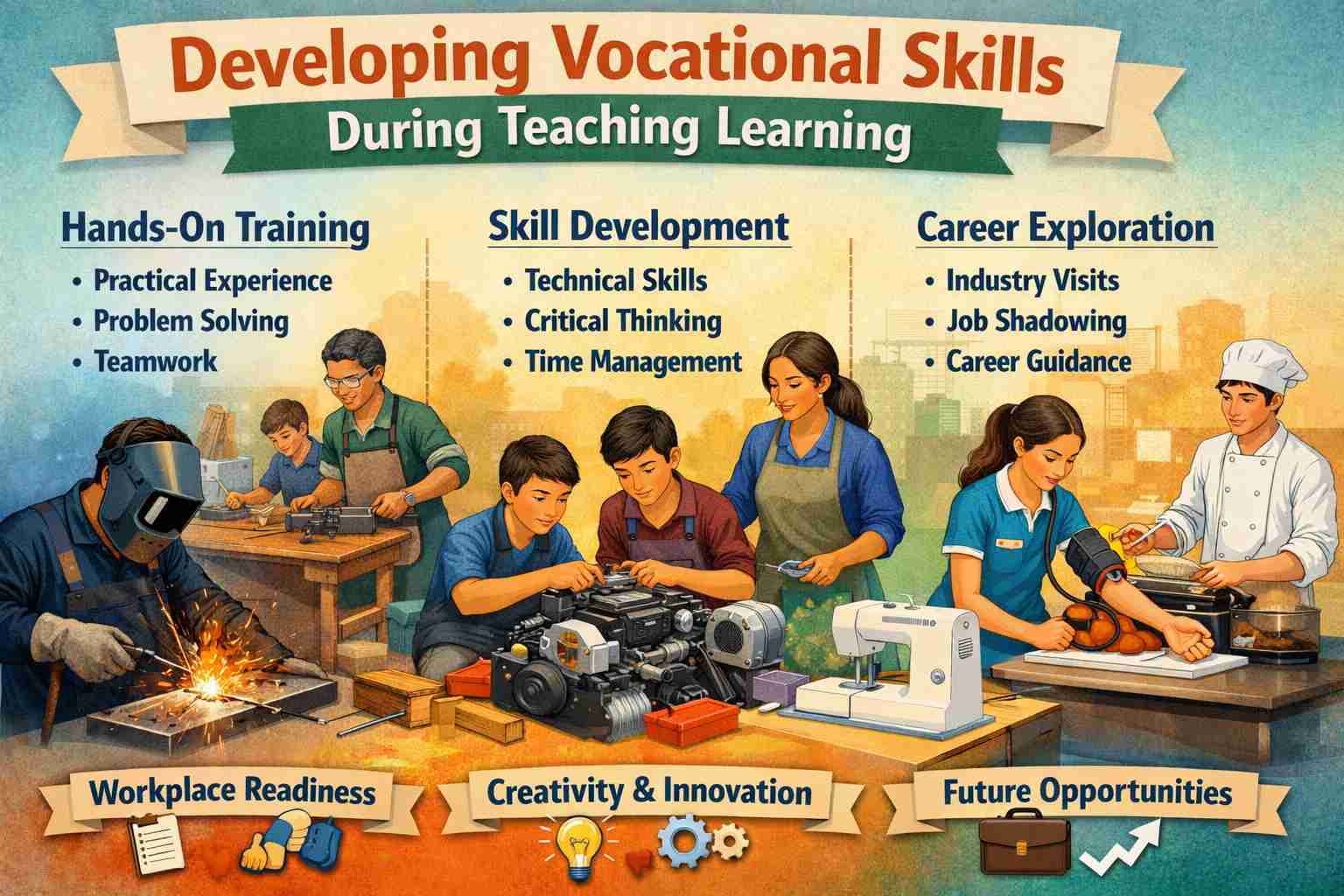
Developing Vocational Skills During Teaching Learning
About this program
A On-Line Lecture on “Developing Vocational Skills During Teaching Learning” by Dr. V. S. Mehrotra, Professor, NCERT, PSSCIVE, Bhopal (M.P.) Organize by DAKSHTAA Vocational Education will prepare students for meaningful and productive participation in the world of work by learning hands-on abilities and skills (i.e., ‘physically doing’), developing equal respect for head-hands-heart, valuing the dignity of labour, and understanding vocational choices for the future. Therefore, schools must provide students a broad but experiential introduction to different kinds of work, and a deep exposure to and a defined set of practical competencies in least one area of work. Vocational Education draws from and builds on the competencies developed in other curricular areas. For example, Mathematics for calculations and estimations, Social Science to understand the place of work in society and production chains, Science to understand how things work and how their functioning can be improved. Thus, it is complementary to and builds on other curricular areas, and not an isolated area. (NCF SE P 428) Cognitive Development and Vocational skills – Hand to Hand The development of vocational capacities will go hand-in-hand with the development of ‘academic’ or other capacities. Vocational education will be integrated in the educational offerings of all secondary schools in a phased manner over the next decade. (NEP 2020, page 44) It is a serious concern that can only be dealt with by a complete re-imagination of how vocational education is offered to students in the future. This policy aims to overcome the social status hierarchy associated with vocational education and requires integration of vocational education programmes into mainstream education in all education institutions in a phased manner. Beginning with vocational exposure at early ages in middle and secondary school, quality vocational education will be integrated smoothly into higher education. It will ensure that every child learns at least one vocation and is exposed to several more. This would lead to emphasizing the dignity of labour and importance of various vocations involving /Indian arts and artisanship. (NEP 2020, page 44) Programme Description Cognitive development and vocational skills are intrinsically linked and can be developed together through hands-on, experiential learning. Vocational skills, which involve practical, real-world applications, provide opportunities for cognitive development through problem-solving, critical thinking, and adapting to new situations. Conversely, strong cognitive abilities are essential for effectively learning and applying vocational skills. Teachers can integrate vocational skills development into their teaching by connecting classroom learning to real-world applications, incorporating practical projects, and fostering a culture of continuous learning and professional development.