About this program
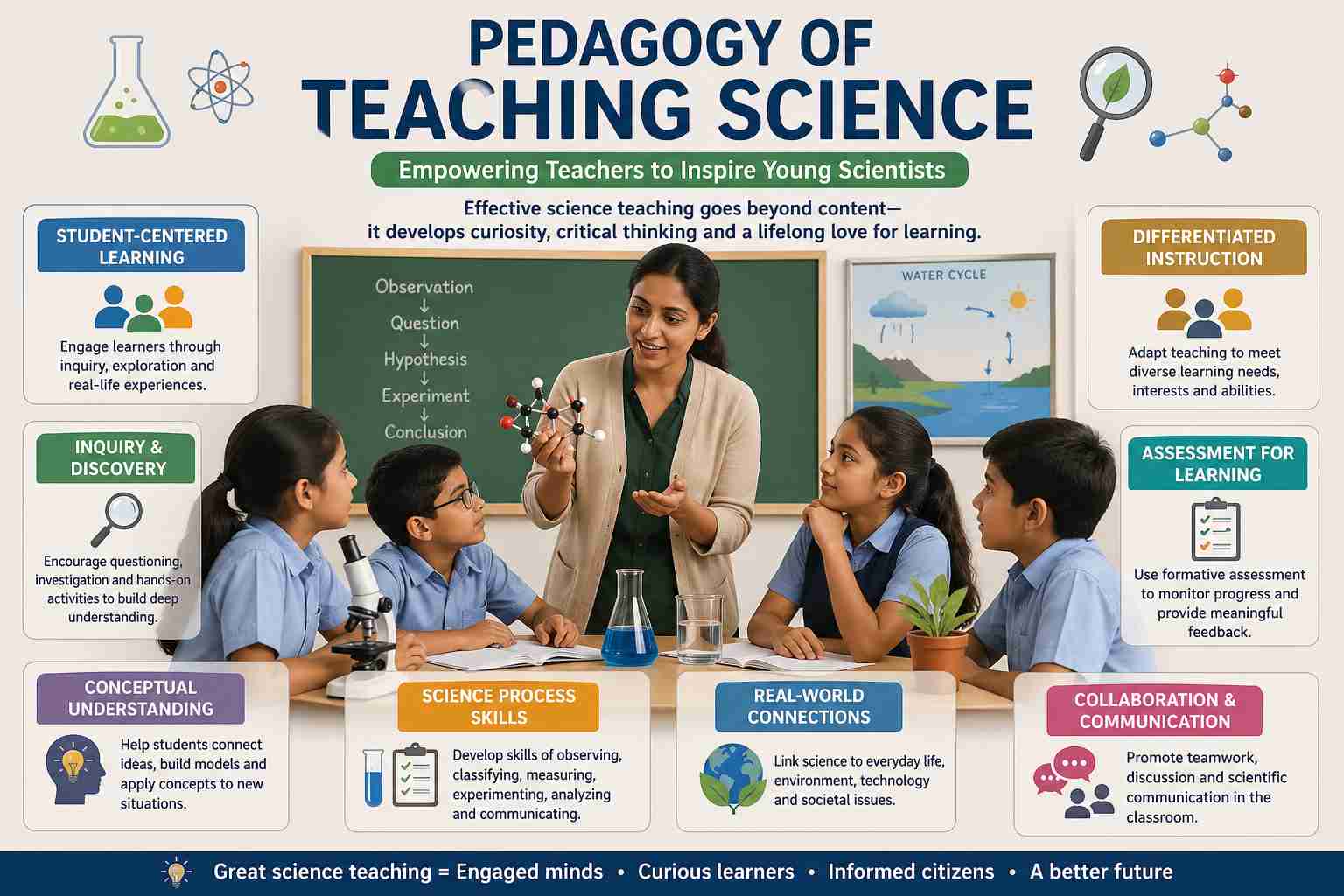
Two Days On-Line Programme on “Pedagogy of Teaching Science” for Teachers Developing Pedagogical Skills in Social Sciences: Science Education gives equal emphasis to acquiring capacities for scientific inquiry and conceptual understanding of theories, laws, and principles in science. Through these capacities and concepts, students are expected to develop a scientific understanding of how the physical natural world functions. While scientific knowledge has exploded, expecting to include all this knowledge in the school curriculum, where time and space are limited, results in unnecessary burden on students. Content for Science Education is chosen to be limited to its essential core to give adequate space and time for developing important capacities for scientific inquiry, such as the ability to put forth questions, observations, hypotheses, experiments, arguments, predictions, and data analysis. Science (also sometimes referred to in this NCF as the Natural Sciences) is a form of understanding the natural world. It has its own specific methods of inquiry, reasoning, theories, and concepts. Beyond aiding in gaining an understanding of the natural phenomena around us, Science Education helps develop rational thought and scientific temper participation (National Curriculum Framework – SE 2023, p. 59) Science aims to develop an understanding of the natural and physical world through systematic inquiry. Learning Science also builds important capacities such as observation, analysis, and inference. This in turn enables the meaningful participation of individuals in society and the world of work with scientific temper, critical and evidence-based thinking, asking relevant questions, analysing practices and norms, and acting for necessary change. Science Education aims to achieve: a. Scientific understanding of the natural and physical world. b. Capacities for scientific inquiry. c. Understanding the evolution of scientific knowledge. d. Interdisciplinary understanding between Science and other curricular areas. e. Understanding of the relationship between Science, Technology, and Society. f. Scientific temper. g. Creativity. Programme Description: During the teaching learning process the pedagogical skills of a teacher helps in developing competencies among their students. The teacher need to integrate other subjects also while teaching science. The programme helps to develop pedagogical and assessment skills among teachers in science. After successful completion of the programme participants will be given “Certificate of Participation”. The objective of the programme is to enhance their knowledge and skills in the area of- • Learning Outcomes for teaching science • Innovations in teaching strategies – experiential, discovery, inductive thinking, concept mapping, concept attainment, blended learning etc. • Techniques for formative and summative assessment Out of school activities for learning science At the end of the programme the participant will be able to understand the concept of Learning Outcome and Competencies in science. They will be able to use innovative pedagogy and may use different techniques of formative and summative assessment for achieving Learning Outcome in science.