
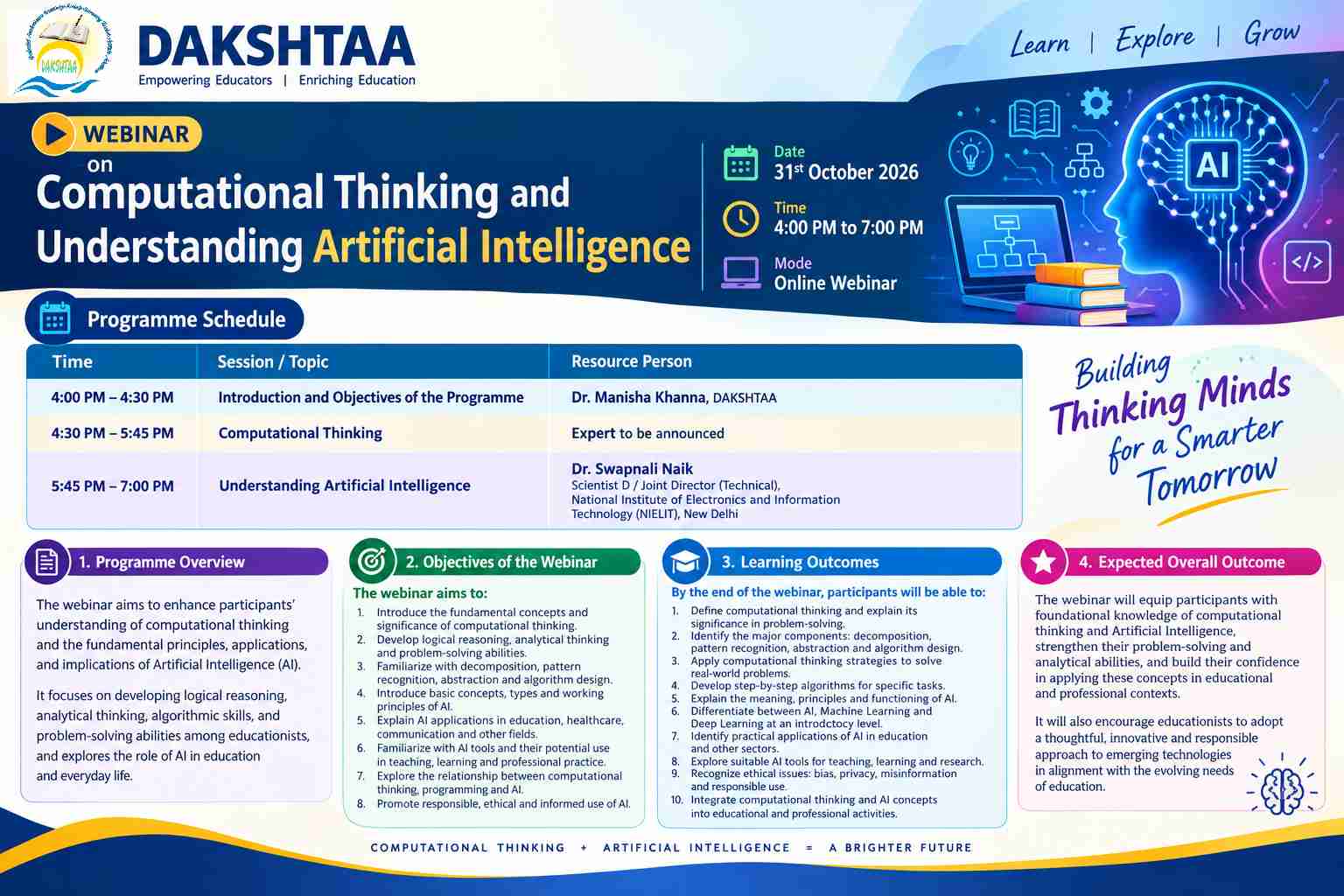
Webinar on “Computational Thinking and Understanding Artificial Intelligence”
About this program
Webinar on “Computational Thinking and Understanding Artificial Intelligence” Date: 31st October 2026 Time: 4:00 pm to 7:00 pm 4:00 pm to 4:30 pm – Introduction and Objectives of the Program Dr. Manisha Khanna, DAKSHTAA 4:30 PM TO 5:45 PM – Computational Thinking Expert: Dr. Ritwik M, Assistant Professor, Department of Computer Science and Engineering, School of Engineering, Coimbatore Campus Amrita Vishwa Vidyapeetham. 5:45 to 7:00 pm – Understanding Artificial Intelligence Expert: Sarika Yadav, Centre of Computer Education and Training, Institute of Professional Studies, University of Allahabad Computational Thinking and Understanding Artificial Intelligence 1. Programme Overview Webinar on “Computational Thinking and Understanding Artificial Intelligence” aims to enhance participants’ understanding of computational thinking concepts and the fundamental principles, applications, and implications of Artificial Intelligence (AI). The webinar focuses on developing problem-solving skills, logical reasoning, algorithmic thinking, and awareness of the role of AI in education and everyday life among educationists. 2. Objectives of the Webinar: The objectives of the webinar are to: 1. Introduce participants to the fundamental concepts and importance of computational thinking. 2. Develop logical reasoning, analytical thinking, and problem-solving abilities. 3. Familiarize participants with the key components of computational thinking, including decomposition, pattern recognition, abstraction, and algorithm design. 4. Introduce the basic concepts, types, and working principles of Artificial Intelligence. 5. Explain the applications of AI in education, healthcare, communication, and other fields. 6. Develop awareness of AI tools and their potential use in teaching, learning, and professional practice. 7. Encourage participants to explore the relationship between computational thinking, programming, and AI. 8. Promote responsible, ethical, and informed use of AI technologies. 3. Learning Outcomes By the end of the webinar, participants will be able to: 1. Define computational thinking and explain its significance in problem-solving. 2. Identify the major components of computational thinking: decomposition, pattern recognition, abstraction, and algorithm design. 3. Apply computational thinking strategies to solve simple real-world problems. 4. Develop step-by-step algorithms to perform specific tasks. 5. Explain the meaning, basic principles, and functioning of Artificial Intelligence. 6. Differentiate between Artificial Intelligence, Machine Learning, and Deep Learning at an introductory level. 7. Identify practical applications of AI in education and other sectors. 8. Explore suitable AI tools for supporting teaching, learning, and research. 9. Recognize ethical issues related to AI, including bias, privacy, misinformation, and responsible use. 10. Integrate computational thinking and AI concepts into appropriate educational and professional activities. 11. Expected overall outcome: Participants will develop foundational knowledge of computational thinking and Artificial Intelligence and gain the confidence to apply these concepts in educational and professional contexts.